Olivier Langlois's blog
 BOOKS i'm reading


Categories: Recommended books, C++, Code Optimization, Compiler, Fractal, Linux/UNIX, Multithreading, Rare out of print, Software security, TCP/IP, Windows programming
01/03/16


C++ in the city in 2016 (0x07E0)
This is an editorial that I sent out to my LinkedIn C++ group members:
https://www.linkedin.com/groups/2035024/2035024-6089655206256144384
I'm discussing the retirement of of one of my favorite C++ books author: Scott Meyers
I am remembering the context when Scott Meyers books were hot and just out of the printers in the 90s. What other books of the same era that did pass as well the test of time.
I'm telling what he was meaning for me as a C++ developer and I am inviting people to discuss the impact and the causes of Mr. Meyers retirement.
Go read about it. It is very good!
06/19/15
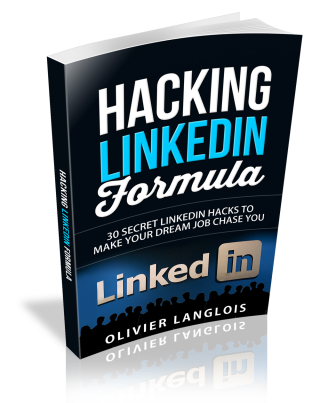
Double Your Odds oF Getting Your Dream position in 14 DaYs or Less
My first book is now available:
http://getjobinterviewsfortechpros.com/
05/27/15
Improve 3 elements in your resume or your linkedin profile to double their effectiveness
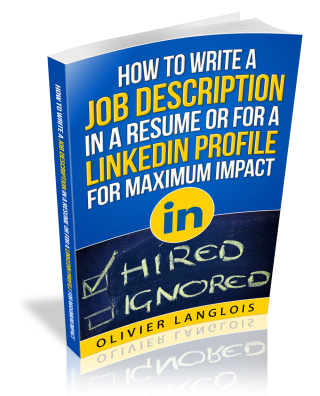
free ebook where I show how to write a job description in a resume or for a linkedin profile for a MAXIMUM IMPACT.
http://getjobinterviewsfortechpros.com/free-job-description-advices-offer.html
05/24/10
Large Scale C++ Software Design
It is a very interesting book. Anyone having been involved in a large scale software development projects will recognize typical problems often seen in this type of projects while reading this book and by experience we have developed an intuition about how to deal with the complexity inherent to large scale projects. Mr Lakos book is the first, to my knowledge, that address this subject and it formalize extremely well the problems of large scale projects and propose a methodology and principles to apply to keep the development and maintainability of these projects manageable. It is a very refreshing C++ book and I recommend it to any C++ professionals not having read it yet.
The most interesting chapters in my opinion are chapter 5 and chapter 6. Chapter 5 presents refactoring methods to remove cyclical dependencies among components, reduce inter dependencies and how to layout components into software layers that will ease reusability and maintainability. Chapter 6 discuss about component insulation. Its difference with encapsulation, the benefits of component insulation and its cost and when it is wise to avoid insulation.
08/22/08
Ruminations on C++
I have got interested in this book because I have read from many sources on Mr. Koenig involvement in several key elements of the C++ language such as argument dependant lookup (ADL), also called the Koenig lookup, and the intersect rule for function overloading. In fact, if you read the book 'The design and evolution of C++', Andrew Koenig name is omni present throughout the book. So I was curious to see what Mr. Koenig had to say on C++.
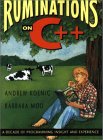
Reading this book has been like a roller coaster ride. First, the cover is intriguing with its recursive pattern where you can see a girl under a tree in a field with cows in the background reading the 'Ruminations on C++' book with the same cover repeating itself over and over. Then the book is divided into six parts and, in my opinion, not all parts are equally good. The first part is taking a more philosophical view on what the C++ language aims to achieve. This part is not too technical and it has somehow a lot of appeal to my eyes. While reading this part, I was thinking that this was very promising for what was to come.
Then at the second part, it is where things are getting spoiled. Part 2 is describing basic C++ techniques. It is not bad but by having read tons of C++ books, to appreciate one of them, I must find some originality that I haven't found in part 2. This part of the book is average.
Finally, I have changed another time my opinion on the book when I have reached part3. Part3 covers templates and more specifically it recreates the whole though process that the STL designers went through to create STL. I see a lot of value to this kind of activities as I believe that understanding why certain things are done in a certain way can help you to better use those things.
In conclusion, I can recommend this book because I feel that mister Koenig goes beyond just the language syntax and try to teach a though process that someone has to go through to solve programming problems. This is a pedagogical approach not found in every programming book.
:: Next Page >>
Olivier Langlois's blog
I want you to find in this blog informations about C++ programming that I had a hard time to find in the first place on the web.
| Next >
| Sun | Mon | Tue | Wed | Thu | Fri | Sat |
|---|---|---|---|---|---|---|
| << < | > >> | |||||
| 1 | 2 | 3 | ||||
| 4 | 5 | 6 | 7 | 8 | 9 | 10 |
| 11 | 12 | 13 | 14 | 15 | 16 | 17 |
| 18 | 19 | 20 | 21 | 22 | 23 | 24 |
| 25 | 26 | 27 | 28 | 29 | 30 | 31 |
Search

Categories
Olivier Langlois's blog
- AAC (2)
- Book reviews (12)
- C++ (24)
- Code Optimization (4)
- Compiler (3)
- Fractal (2)
- Linux/UNIX (3)
- Multithreading (3)
- Software security (7)
- TCP/IP (8)
- Web (1)
- Windows programming (19)
- C++ (28)
- tutorials (4)
- General (10)
- Hardware reviews (2)
- Linux (12)
- Recommended books (4)
- C++ (20)
- Code Optimization (2)
- Compiler (3)
- Fractal (2)
- Linux/UNIX (1)
- Multithreading (2)
- Rare out of print (3)
- Software security (5)
- TCP/IP (7)
- Windows programming (16)
- Software reviews (0)
- TCP/IP (8)
- Video games (4)
Archives
- January 2016 (1)
- September 2015 (1)
- July 2015 (1)
- June 2015 (1)
- May 2015 (1)
- December 2013 (3)
- September 2013 (1)
- May 2013 (8)
- April 2013 (1)
- December 2010 (1)
- August 2010 (1)
- June 2010 (1)
- More...
Misc
 XML Feeds
What is RSS?
Who's Online?
- Guest Users: 4
powered by

Contact the admin • b2evo skins design by François / Evo Factory. • Credits: evoCore | green webhost
